SALARIES HAVE DRIVEN MANY GOOD TEACHERS AWAY.
There are more than 3,000 open teacher positions listed on the Indiana Department of Education website as of this writing. “Quality educators are in high demand,” says Aerin Welch, Ph.D., interim program director for the Department of Psychological Sciences at the University of Indianapolis (UIndy). “The people really wanting to pursue education are still out there, but recruitment here has gotten progressively harder.” It’s not difficult to see why. Our average teacher pay ranks 38th in the nation. So the best educators are leaving the state in droves for greener pastures. While the average Hoosier teacher salary did increase 4 percent from the 2024–2025 to 2025–2026 school years, median wages for teachers (and administrators) show a decline since 2020 once adjusted for inflation. Salaries have gone up, but not nearly at the same pace as the cost of living has.
AND NOW, THE POOL OF SCHOOL PSYCHOLOGISTS IS DRYING UP TOO.
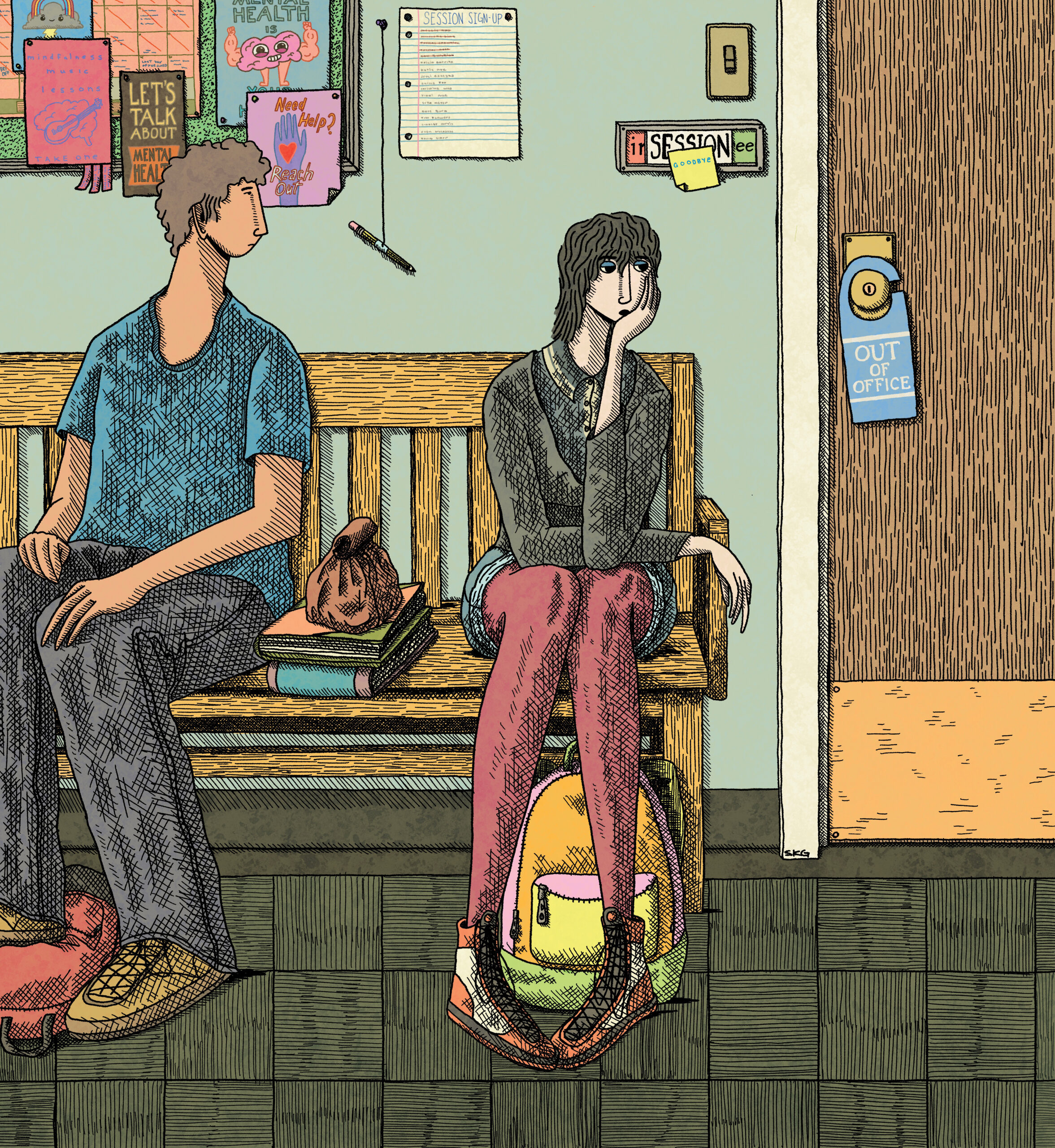
A new survey of Indiana school superintendents and administrators reports the school psychologist-to-student ratio is 357:1. The recommended ratio is 250:1. The resulting overload and stress has led to high turnover, leaving students who rely on special education services to struggle on without them.
INDIANA LACKS MENTAL HEALTH PROVIDERS IN GENERAL.
According to the 2024 Mental Health America report, the most recent available, 66.4 percent of Indiana teens who experience major depression do not receive necessary treatment, an increase of nearly 11 percent from 2023. That’s far worse than the national average. At the same time, the Indiana Department of Health reports all 92 of Indiana’s counties have a mental health provider shortage, mirroring similar gaps inside of schools. Four rural counties—Newton, Ohio, Switzerland, and Union—have zero mental health professionals practicing within their borders. Couple this data with the lack of available in-school resources, and many kids who need support aren’t getting it anywhere.
FARMING OUT THE JOB IS A BAND-AID.
In the last few years, some larger districts have begun outsourcing the school psychologist role to third-party contractors. While the support they provide is better than nothing, of course, students, especially those with more complex needs, aren’t necessarily getting the best help for their individual situations. “It’s less of a partnership—a collaborative relationship—than it is someone coming in and saying, ‘We did the testing, and it looks like this,’” Welch says. “They’ll make recommendations without being an actual part of the district or the school system.” Welch also points out the high cost of contracting out the work. School systems end up paying both the psychologists’ salaries and fees to a staffing agency.
UINDY IS KICK-STARTING AN INNOVATIVE SOLUTION.
Welch was inspired to start a new program at UIndy after experiencing the consequences of psychologist staffing shortages first-hand. “What happens is school psychologists are so overwhelmed with the testing that’s being requested, with [the papers] needing to be signed, and basically catching up versus really being able to work in a preventative way,” Welch says. The time-squeezed psychologists rely on intervention instead of preventing learning loss. “We’re not able to really function at that preventative level in most districts,” she adds.
Though Indiana University Bloomington, Indiana State University, and Ball State University have their own graduate tracks, the UIndy program is specifically geared toward working adults who don’t have the time or resources to become full-time students again. Applicants must have at least 18 credit hours in psychology and education prerequisites to enroll. Students in the program can earn both a Master of Arts and an Education Specialist (Ed.S.) degree over the course of two years through evening courses and asynchronous learning. Students who pursue the Ed.S. degree must then complete a one-year internship in a public school district. The program operates on a small class-size model with approximately 12 students per section to allow for individual attention and faculty mentorship.
IT WILL TAKE A VILLAGE.
Students meet online one night a week to go over lecture material with faculty available to answer questions in real time. “A big goal is community building, because we are going to be a statewide program,” Welch says. “It’s going to allow us to get together and collaborate, commiserate, and just share our experiences, because you’re not going to have the same challenges in a smaller district as you might working in Indianapolis Public Schools.”
MORE NONTRADITIONAL PATHWAYS IN SCHOOLS ARE NEEDED.
Welch is hopeful that other institutions will follow UIndy’s lead to help bolster the ranks of child advocates in schools through nontraditional programs. “At the end of the day, are we advocating for what’s best for this child?” she says. “Sometimes that means recommending against special education services for a child who is able to progress with their peers, because removing them from the classroom for any amount of time can be detrimental. Other times, it means advocating for more time in special education. It really has to be about the student’s individual needs, not the needs of the school or even necessarily the needs of the parent.” As Indiana schools continue to face staffing shortages alongside growing student mental health needs, UIndy leaders predict its program will be the start of an evolving solution.
The Shortage In Schools: By The Numbers
357:1
Ratio of students to school psychologists in Indiana
38th
Indiana’s ranking for teacher pay nationwide
66.4 percent
Percentage of Indiana teens experiencing major depression who don’t receive needed treatment
92
Indiana counties (all of them) that have a mental health provider shortage