


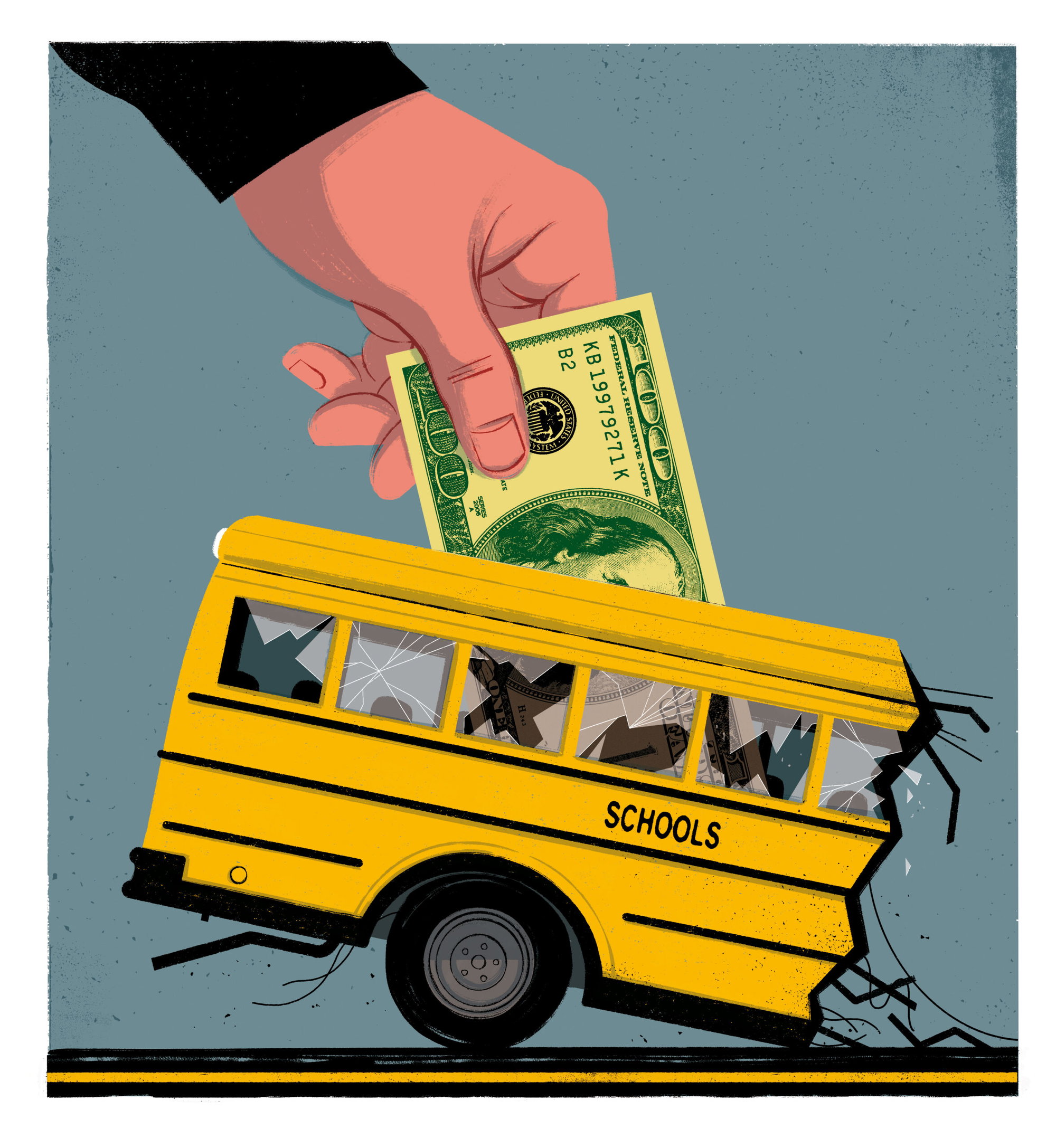
New legislation has completely altered the landscape of education in Indianapolis.
Recently passed laws established the Indianapolis Public Education Corporation, or IPEC, a nine-member board appointed by the mayor to oversee the district’s 48 traditional IPS and 60 participating charter schools, as well as split future tax revenues equally between traditional and charter schools. While the elected seven-member IPS board and the boards of independent charter schools continue to make decisions about staffing, curriculum, instruction, and budgeting for their own schools and networks, IPEC took over responsibility this year for the district’s transportation, facilities, and taxation and proposed a four-year operating referendum in June.
The referendum will introduce a new property tax rate to fund education, but that funding won’t just go to the city’s traditional public schools alone.
The new rate of 37.2 cents per $100 of home valuation would replace the 19.6-cent rate that ends this calendar year. The $95 million that would be raised would be split evenly between the 48 IPS and 60 charter schools under IPEC—which would leave a roughly $40 million gap in IPS funding.
It’s no secret that IPS has been under strain for a while.
The state’s legislative shift a decade ago to favor school choice has steadily siphoned students from traditional public schools into public charter schools. Enrollment over the last 10 years in independent charter schools and those partnered with IPS in the Innovation Network has increased 88 percent to more than 27,400 students—or 62 percent of the current total, according to a state data analysis by The Mind Trust, a pro-charter advocacy group. Over the same period, total enrollment in IPS-operated schools dropped by 39 percent to 17,087. Lower enrollment means less funding.
IPS has already made cuts to use its budget more efficiently.
In response to enrollment declines and funding shifts, the current IPS budget of $490 million represents a cut of $24 million. Most of those cuts—$17 million—came from the district’s central office. The other $7 million was reduced at the school level.
The portion of the referendum used by IPS will go toward improving faculty pay and student support services, especially for those who are under-served.
IPS says it will use the revenue to “sustain competitive teacher and staff pay” and enhance “essential student support services, including special education services and learning interventions.” This encompasses programs for English learners and those with disabilities, early college credit courses, and work-based learning opportunities. According to Chalkbeat, a nonprofit media group covering public education, of the 42,000 Indianapolis students in traditional schools, semi-autonomous innovation schools, and independent charter schools, about 85 percent are students of color, and 30 percent are English learners. As of September, only some charters have articulated what their portion would go toward.
The Rebuilding Stronger program, implemented BEGINNING in 2024–25, is still underway, and no one knows how it will factor into the newest changes.
IPS officials wouldn’t comment as of this writing on how the Rebuilding Stronger program will move forward, but Michael O’Connor, former acting director of IPEC, says passage or defeat of the referendum isn’t likely to affect it since it was financed by a separate $400 million capital improvements referendum passed in 2022. The 10-year program is aimed at reconfiguring IPS elementary and middle schools, giving families more access to schools outside their neighborhoods, consolidating and upgrading facilities, and expanding curriculum offerings for students.
Passage of the referendum won’t restore IPS’ free pre-K program, which was eliminated by state cuts in 2025, OR stop school closures.
State legislators are talking about other ways of bringing back the popular pre-K program. The state law passed in March also exempts IPS from Indiana’s requirement that traditional public schools sell closed buildings to charter operators for $1. O’Connor says the new law addresses the problem of too many schools for too few students. Even if the referendum passes, more school closings are likely, which will “‘right size’ both traditional public schools and public charter schools [and] create more efficiency.”
It’s true that charter schools outperform traditional public schools, but public schools serve a wider and larger population.
A recent study by the Annenberg Institute at Brown University found that Indiana public charter school students bounced back from the pandemic faster than their peers in traditional public schools. However, Christopher Lubienski, director of Indiana’s Center for Evaluation and Education Policy, points out that charter schools tend to attract students whose parents are able to invest more time and focus on their children’s education and often lack the resources to admit students who need extra attention. Traditional public schools, he says, “tend to serve a greater proportion of students with special needs [and] students with limited English proficiency or with greater academic needs.”
No one knows exactly how IPS will fare if the referendum is voted down.
On top of managing $24 million in cuts this past spring and another $20 million to be made by next school year, surviving the loss of $45 million annually over the next four years could require IPS to resort to “Draconian measures,” O’Connor says. Superintendent Aleesia Johnson says the referendum’s defeat could lead to a state takeover of the district. The IPS website claims that “a shortfall like this could lead to staffing freezes, reduced transportation, the potential closure of support programs, and more instability for families and students.” Even so, IPS’ teachers union, the Indianapolis Education Association, has come out in opposition to the referendum, stating that its members do not feel it’s fair to raise taxes on already struggling households when the funds provided won’t be enough to offset the district’s ongoing budget deficit.


