


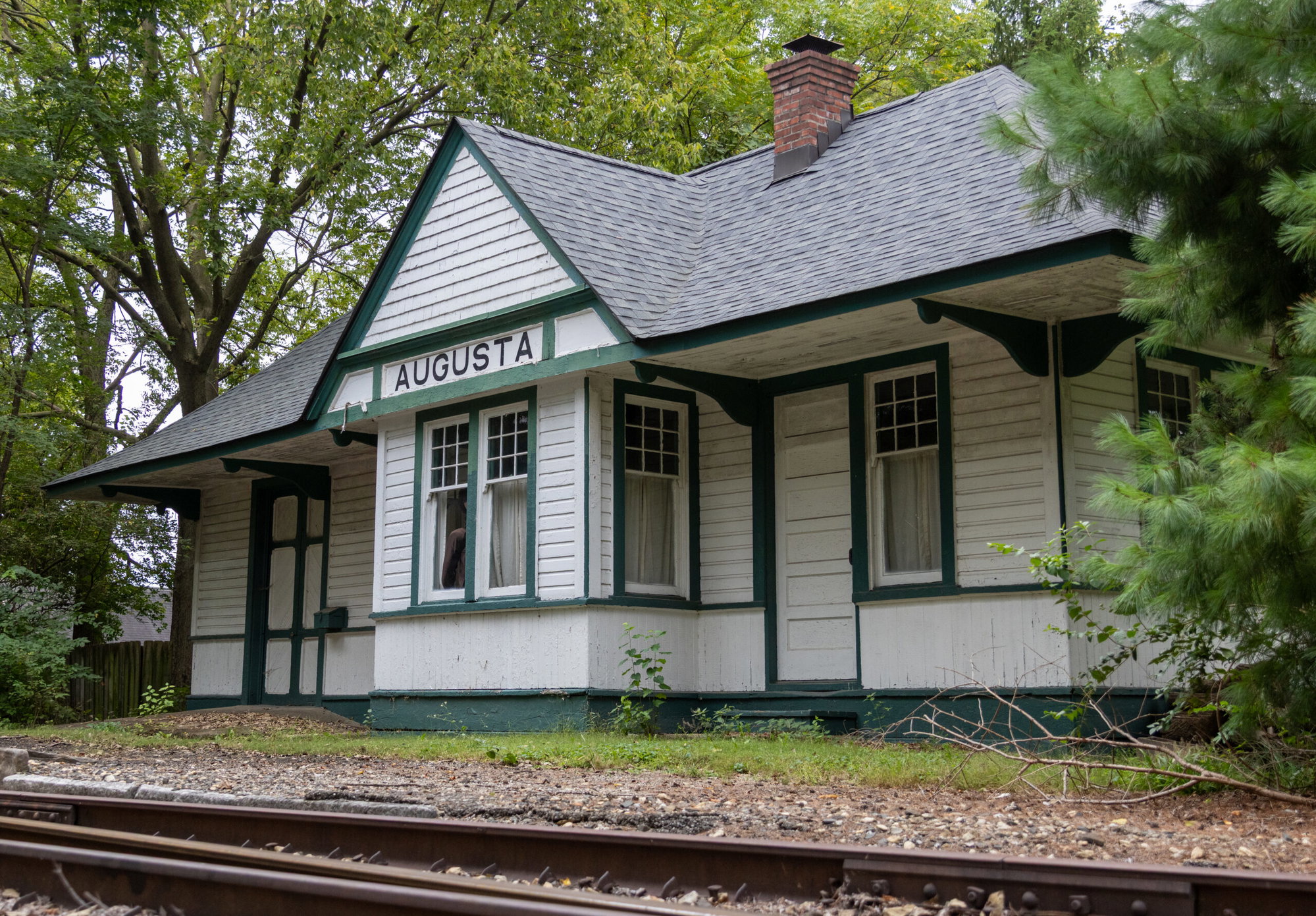
BEFORE THE ADVENT of cars, Indianapolis and the growing number of surrounding communities had begun to establish the area as the “Crossroads of America,” largely through railroad companies crisscrossing the area while the United States was still very much in its infancy as a nation.
During that period, train depots often served as seeds to grow new communities beyond the then-boundaries of major cities.
For example, the area that now spans from 71st Street to 79th Street, with Georgetown and New Augusta roads marking the rectangular boundary, emerged as a result of train track construction.
The village within those boundaries began life as Hosbrook in 1852 after the Indianapolis and Lafayette Railroad expanded. The train depot and post office opened around 1854 to serve Augusta, which sits directly east. Hosbrook saw its share of history come through in the very literal sense, with mourners lining the rail to catch a glimpse of the Lincoln Special, a train-car funeral procession held for President Abraham Lincoln that ran between Washington, D.C., and Springfield, Illinois.
In the late 1870s, the U.S. Postal Service realized Indiana already had a Hosbrook on its ledger of locations, which would’ve created some degree of confusion. As a result, Hosbrook was then given a new moniker: New Augusta.
“New Augusta was the hub of agribusiness for Pike Township,” says New Augusta Village Association president Mark Patty. “It was a farming and railroad community.”
Rebuilt in 1890 following a devastating fire, Augusta Station is in its original location.
The property was most recently owned by the descendants of Olive, Emma, and Mary Purdy, who grew up in New Augusta. The Purdy family is widely considered one of the founding families of the neighborhood and, like many of the first settlers, has a street named after them.
The town was incorporated into Indianapolis’ UniGov consolidation in January of 1970. New Augusta was listed on the National Register of Historic Places in 1989 and then received a local designation through the Indianapolis Historic Preservation Commission in 1999.
Those designations mean a new business or homeowner can’t go wild when building or remodeling.
Although Indianapolis is on a traditional grid pattern, New Augusta’s street makeup is diagonal to run alongside the railroad tracks. The depot, the Odd Fellows Hall, Salem Lutheran Church, as well as a variety of historic barns, carriage houses, homes, and businesses can make one feel like they stepped away from the hustle and bustle of the city and into a community frozen in time.
To that end, New Augusta and Acton in Franklin Township are the only remaining 19th-century railroad towns with intact depots in Marion County.
Although Augusta Station and the relics remain, Patty says the neighborhood is still evolving as new businesses and neighbors come to this small section of Indianapolis for its future potential.


