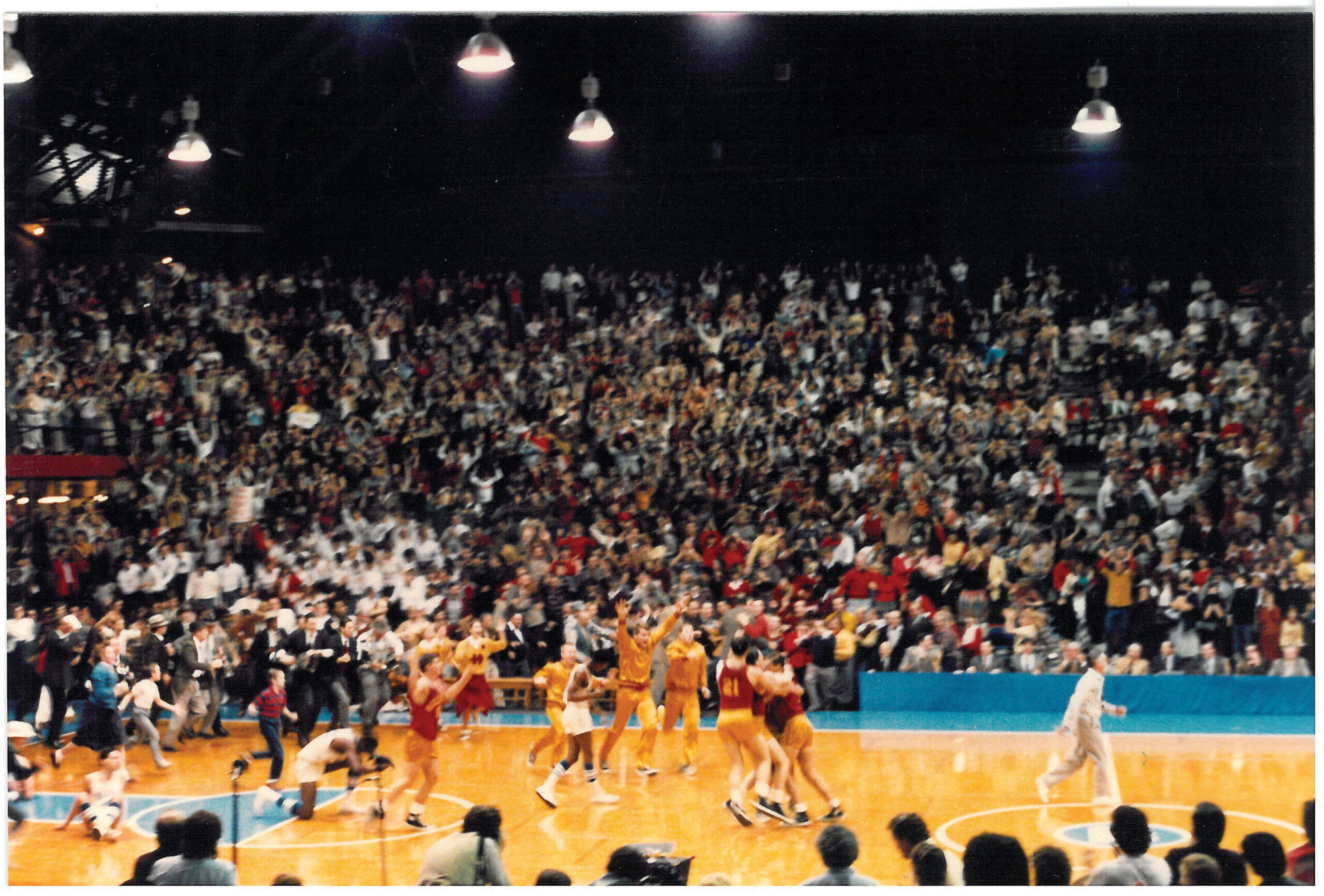
THE MOVIE HOOSIERS turned 40 this year, and it’s arguably a bigger deal now than when it was released in 1986. The fictional reimagining of tiny Milan High School’s 1954 state basketball championship has become a statewide cultural touchstone, and ranks as one of the greatest, if not the greatest, of all sports films.
But back in the day, few saw its potential. Not its director, David Anspaugh, nor its writer, Angelo Pizzo. And certainly not to its star, Gene Hackman.
“We didn’t think we were making some sort of classic,” Pizzo recalls. “Quite the opposite. We felt like we were on the Titanic, and that it was going to be a disaster. We had challenges beyond challenges beyond challenges.”
It certainly didn’t help that Hackman (who starred as coach Norman Dale) and Barbara Hershey (who played schoolteacher Myra Fleener) posed some of the biggest challenges of all. Both were deeply unimpressed with everything from their Indiana surroundings to Anspaugh and Pizzo themselves.
“They thought they got stuck on this amateur night in Dixie production, and they let us know,” Pizzo said. “David in particular had such a tremendous challenge dealing with Gene. He was not hesitant about sharing his unhappiness with being in Indiana shooting this movie.”
Hershey was perhaps even worse. She disliked pretty much every word of the script, saying she only took the gig because she wanted to work with Hackman. Producer Carter DeHaven even told Pizzo that he wasn’t allowed to stand where Hershey could see him when they shot her scenes. And after the movie debuted she refused to promote it, or even to answer questions about it.
When production finally wrapped after a four-day stand at Hinkle Fieldhouse, where the movie’s climactic championship game was shot, Pizzo chased after Hackman as the actor bolted for his trailer. He shook his hand and thanked him for the experience. Hackman, he recalled, gave him a less-than-inspiring take on the movie’s chances of success.
“He said, ‘I’m sure you boys learned a lot,’” Pizzo remembers. “I just want you to really be prepared for the fact that this movie, like most, is going to end up somewhere in the dustbin of film history, a dustbin of films that no one goes to see.”
Hackman was, to put it mildly, incorrect. Made with an extremely modest $6 million budget, Hoosiers went on to earn a respectable $28.6 million during its original theatrical run. Nowhere near as successful as Top Gun or Crocodile Dundee (1986’s two biggest hits), but not bad. It also earned two Oscar nominations, one for best supporting actor for Dennis Hopper, and one for its score, created by Jerry Goldsmith.
And then something truly strange happened. The movie refused to fade away. Created to celebrate Indiana’s peculiar love affair with high school basketball and its almost one-of-a-kind, one-class, winner-take-all state basketball tournament, it somehow became not just a celebration of Hoosier Hysteria, but a part of it. So much so that today some fans are a bit hazy about where the movie ends and the real story of Milan begins.
Matt Martin, executive director of the Indiana Basketball Hall of Fame in New Castle, says visitors occasionally ask him, in all seriousness, where the entirely mythical town of Hickory is located. When Martin explains that Hickory isn’t real, it doesn’t seem to compute.
“Well, I know,” Martin says they’ll respond. “But where is it?”
For a very long time Hickory lived only in the minds of Pizzo and Anspaugh. The two met at Indiana University around 1970, where they bonded over their love of movies.
“One of us once said, ‘Wouldn’t it be crazy if somehow one of us ended up in the film industry, or even both of us?’” Anspaugh recalls.
Then one of them proposed an even crazier idea: If they ever got the chance, they should make a movie about Milan High School and its astonishing 1954 state basketball championship.
“We went, ‘Oh my God, that would be such a great movie,’” Anspaugh says. “That’s where the seed was planted.”
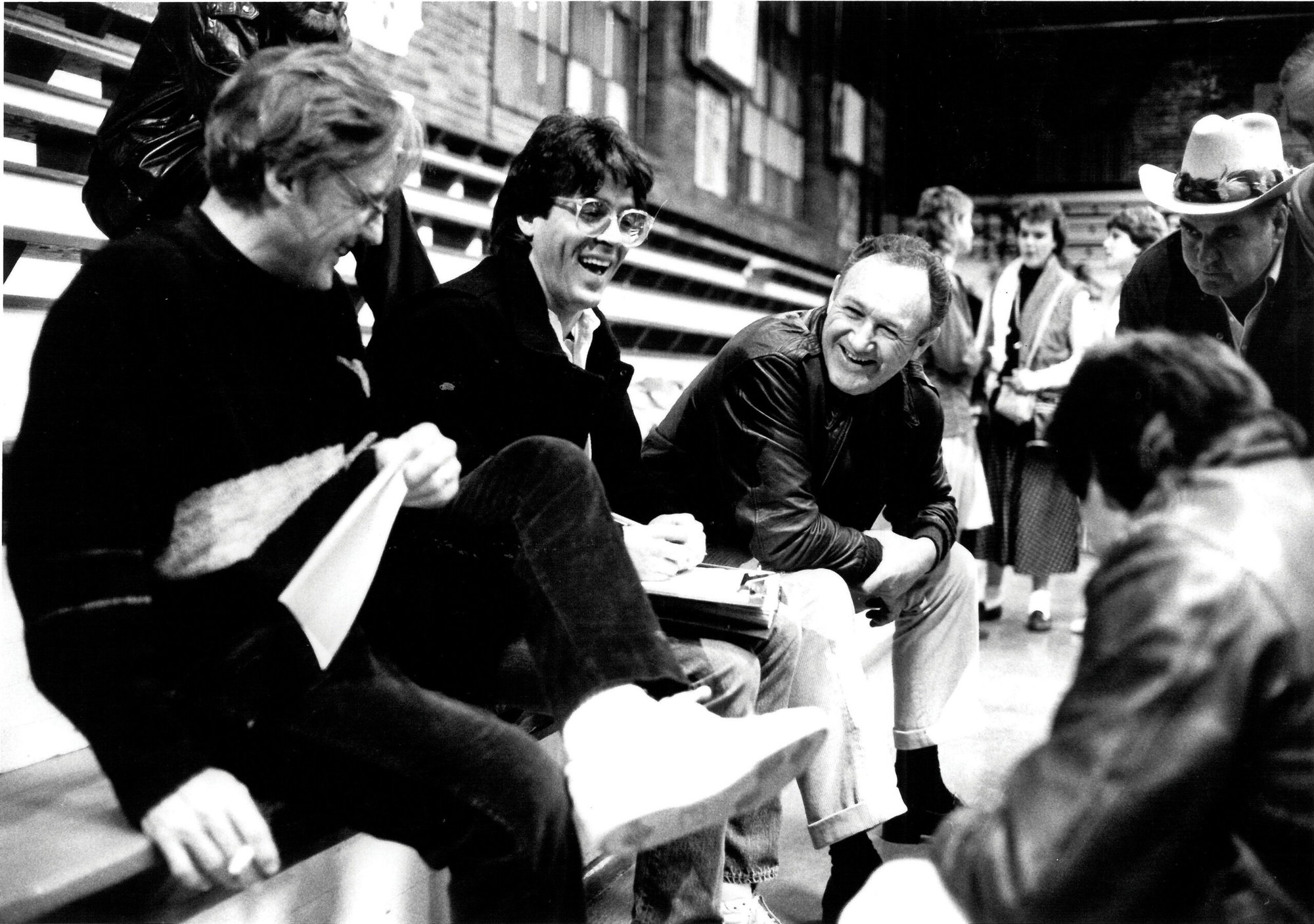
That seed took more than a decade to sprout. Both men attended film school at the University of Southern California, then went their separate ways professionally. Anspaugh became an accomplished television director and won a Directors Guild of America award. Pizzo read and developed scripts and became vice president of feature film production at Time-Life Films. Through it all, the Milan idea simmered on the back burner.
“It was always there,” Pizzo says. “But the plan for how to execute it wasn’t.”
The project took its first tentative steps toward reality in 1981. After Time-Life Films restructured its film production operation, Pizzo returned to Indiana to research Milan’s story and then, he thought, hire someone to write a script. But interviews with actual team members threw a wrench in the works. Turns out Milan’s story was too wholesome. The players grew up together, loved their coach and enjoyed the full support of their town. There was no conflict. And you can’t tell an interesting story without conflict.
“The more I talked to them, the more I realized this could be the world’s most boring movie,” Pizzo recalls.
So he instead decided to write a fictional story inspired by it, giving himself the freedom to invent the town of Hickory, the team’s irascible coach, Norman Dale, and pretty much every single emotional high and low point that makes the movie what it is. Perhaps most importantly, he decided to write the script himself.
It was a grueling process, but nothing compared to finding someone to back the project. Sports movies were considered lousy box office bets, and the major studios passed. But Hoosiers had one heavy hitter in its corner: Jack Nicholson. Anspaugh had befriended him years earlier, and the actor read the script and wanted to play Norman Dale.
“Jack is probably one of the biggest reasons that we got the movie made,” Anspaugh says.
Nicholson ultimately dropped out because of a scheduling conflict, but by then Hoosiers had momentum. In March 1985 Hemdale Film Corporation picked it up, and Orion Pictures eventually came aboard as distributor. The two old IU friends who had stayed up late talking about a Milan movie 15 years earlier finally got a chance to actually do it.
Over the intervening years Pizzo and Anspaugh have watched their fictional account weave itself inextricably into the colorful tapestry of Indiana basketball lore. Typically, at the commemorative events they’ve attended over the years, the celebrity guest list included both actors who portrayed Hickory players and members of the real Milan team. No one seems to mind.
“There’s a kind of a merging of those two stories,” Pizzo says.
During one such gathering he noticed a man he didn’t recognize sitting at the autograph table and apparently presenting himself as the real-life inspiration for Shooter, the alcoholic dad portrayed in Hoosiers by Dennis Hopper. There was just one problem.
“I completely made that character up,” Pizzo says.
The bizarre episode was just one more example of what happens when a fictionalized tale becomes so compelling that it alters how people remember the real story. The movie indeed celebrates Indiana’s love of high school basketball and its wild, winner-take-all state tournament, in which every school, no matter its size, competed. But there’s an inconvenient truth hidden in that nostalgia. Hoosiers landed in theaters just as the state’s near-maniacal, multi-generational fascination with high school hoops was fading. And just before it was changed beyond all recognition.
Attendance for the Indiana High School Athletic Association’s boys’ basketball tournament peaked in 1962 at an astounding 1,554,454. But it was all downhill from there. In 1972 it dropped to 1,332,675; in 1982 to 1,076,886; and in 1992, even in the radiant afterglow of Hoosiers, it dwindled to 861,124.
The reasons for the decline are pretty straightforward. For the first few decades of the 20th century, watching the local high school basketball team was pretty much the only entertainment in lots of tiny Indiana towns. Many lacked the money, or enough students, to even fit out a football team. So the local hoops squad became the community’s sole source of excitement and entertainment during the dregs of winter.
“The place to be on Friday and Saturday night was at your community’s basketball game,” says Steve Witty, executive director emeritus of the Indiana Basketball Coaches Association. “That was the social event of the week. There wasn’t much competition for the entertainment dollar at the time. High school basketball was the only game in town.”
But slowly, the community fabric that underpinned Hoosier Hysteria frayed. It began after World War II, when many small-town schools were closed and gathered together into larger “consolidated” high schools. Decades-old hoops rivalries fought out on basketball courts across the state were erased overnight. In 1938 787 high schools participated in the IHSAA’s hoops tournament, the largest field in history. But by the late ’60s, thanks mostly to consolidation, the field fell to the 400s, then into the 300s before recovering slightly. In 2026 404 schools participated.
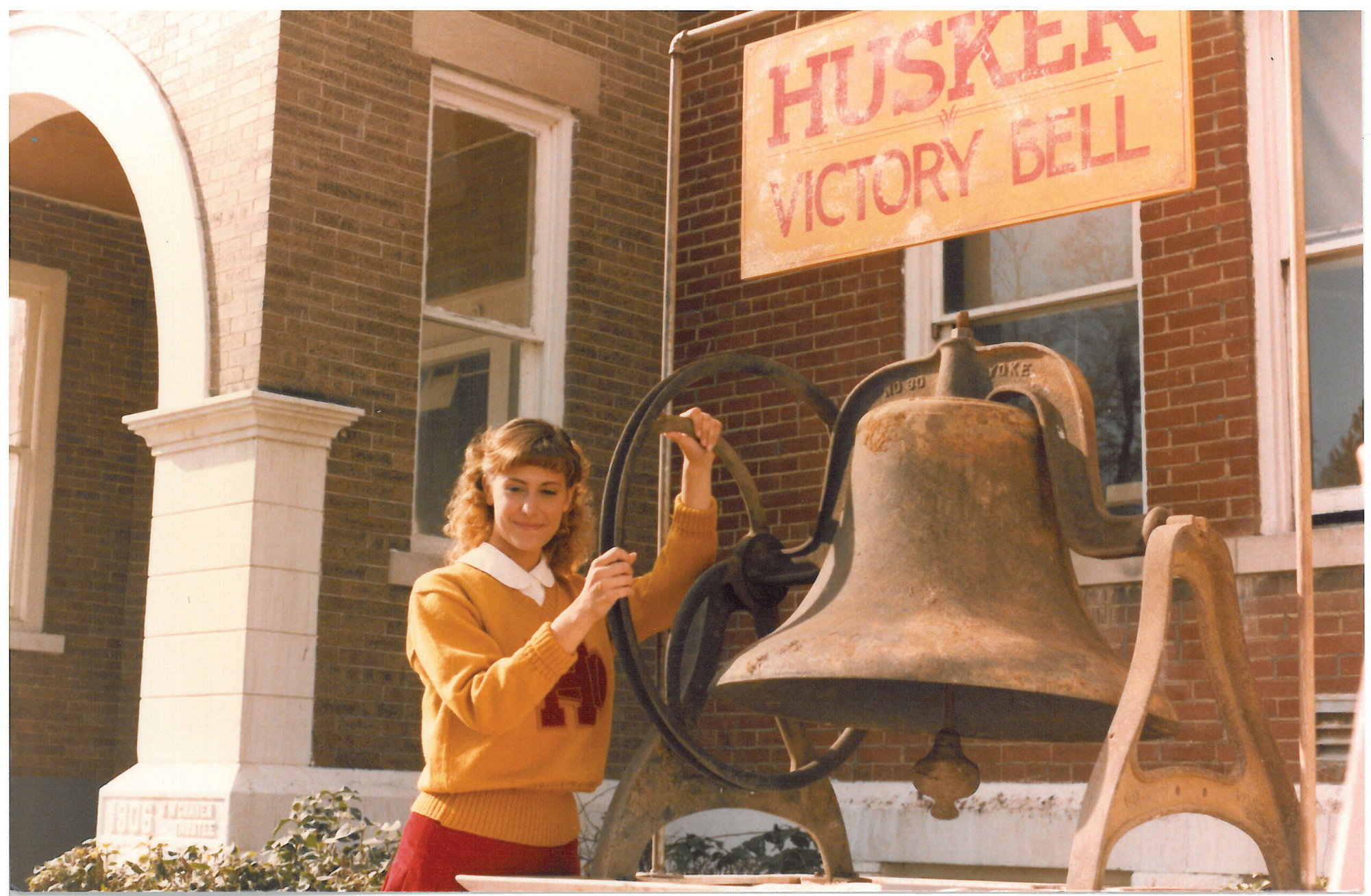
as Hickory cheerleader
Loetta Summers.
That wasn’t the only issue. By the ’60s high school basketball was far from the only game in town. Those consolidated schools could field football teams and lots of other sports teams, too. And there was television. Then cable. Then video games. And now, doom scrolling on phones. All of it drained interest in high school basketball.
But the coup de grace was yet to come.
Much of what made Indiana’s high school basketball tradition so special was its one-class, winner-take-all championship tournament. Initiated in 1911, it meant that any little crossroads town had a shot, however small, at winning the state title. Most of the time, when little schools faced big ones in the tournament, the little schools got smashed.
Except, of course, for that one time. That time they made a movie about.
By 1996, Indiana was one of only four states, along with Kentucky, Delaware and Hawaii, still holding a single-class basketball tournament. Trouble was, the size disparity between schools grew ever more daunting. For instance, if Milan High School (yes, it still exists) which enrolled 315 students in 2024-’25, made another title run in a winner-take-all tournament, it might face behemoths such as Carmel High School, with an enrollment surpassing 5,000.
But Milan will never again face such a patently unfair contest. Because doing what the school’s 1954 team did is impossible now. It’s against the rules.
On April 29, 1996 the Indiana High School Athletic Association (IHSAA) board of directors voted 12-5 to create multi-class tournaments in several team sports, including boys and girls basketball. Today, Indiana divides its high schools into four basketball classes based primarily on enrollment. The largest 20 percent compete in Class 4A; the next 25 percent in 3A; the next 25 percent in 2A; and the smallest 30 percent in 1A, with each class crowning its own state champion.
The last one-winner tournament was played in 1997, when Bloomington North defeated Delta 75-54. Some 786,024 fans attended. The next year, four different champions were crowned, and total tournament attendance tumbled to approximately 434,752.
Opponents said the new system destroyed what made Indiana’s high school game unique. The IHSAA countered that the enormous and growing enrollment gap between Indiana’s largest and smallest schools made the old tournament fundamentally unfair.
“We wouldn’t pit a 3,500-student school against a 300-student school in an IHSAA basketball tournament any more than we would match a 198-pound wrestler against a youngster that weighs 106 pounds,” said then-IHSAA commissioner Bobby Cox in a 2012 essay published on the IHSAA website.
The irony, of course, is that the very unfairness the change was intended to eliminate was also what made the old tournament so compelling. David was allowed to face Goliath.
Pretty much the only place you can see such a contest these days is by re-watching Hoosiers. Witty introduced his grandson, who doesn’t live in Indiana, to Hoosier Hysteria by showing him the movie when he was 10. Now they watch it together once a year, every year.
“In my opinion, Pizzo and Anspaugh are geniuses,” Witty said. “They did such a great job of capturing the essence of how high school basketball was one of our state’s great treasures.”
This year also brings a new, longer version of the movie. Anspaugh says he spent years lobbying for a director’s cut that restores material removed from the theatrical release, including scenes that clear up some of the original film’s unanswered questions and develop its story more fully. At the time of this interview, Anspaugh says the extended cut has already been screened for selected audiences and is expected to become available to the general public soon.
“I’m so proud of it,” he says. “If you look at the new one, it’s a better film and there are more stories and more questions answered. It’s a different film and it’s better.”
Perhaps. But the average fan might take issue with the suggestion, even from its director, that Hoosiers needs any sort of improvement. It’s a fictionalized saga that plays fast and loose with the actual Milan championship, but in doing so it weaves a story about Indiana basketball that’s fundamentally real. And it makes anyone who witnessed true Hoosier Hysteria pine for a time that’s gone forever. The underdog will never again prevail. David will never again slay Goliath. It only happened once. But it did happen. And Hoosiers preserved it in amber.