


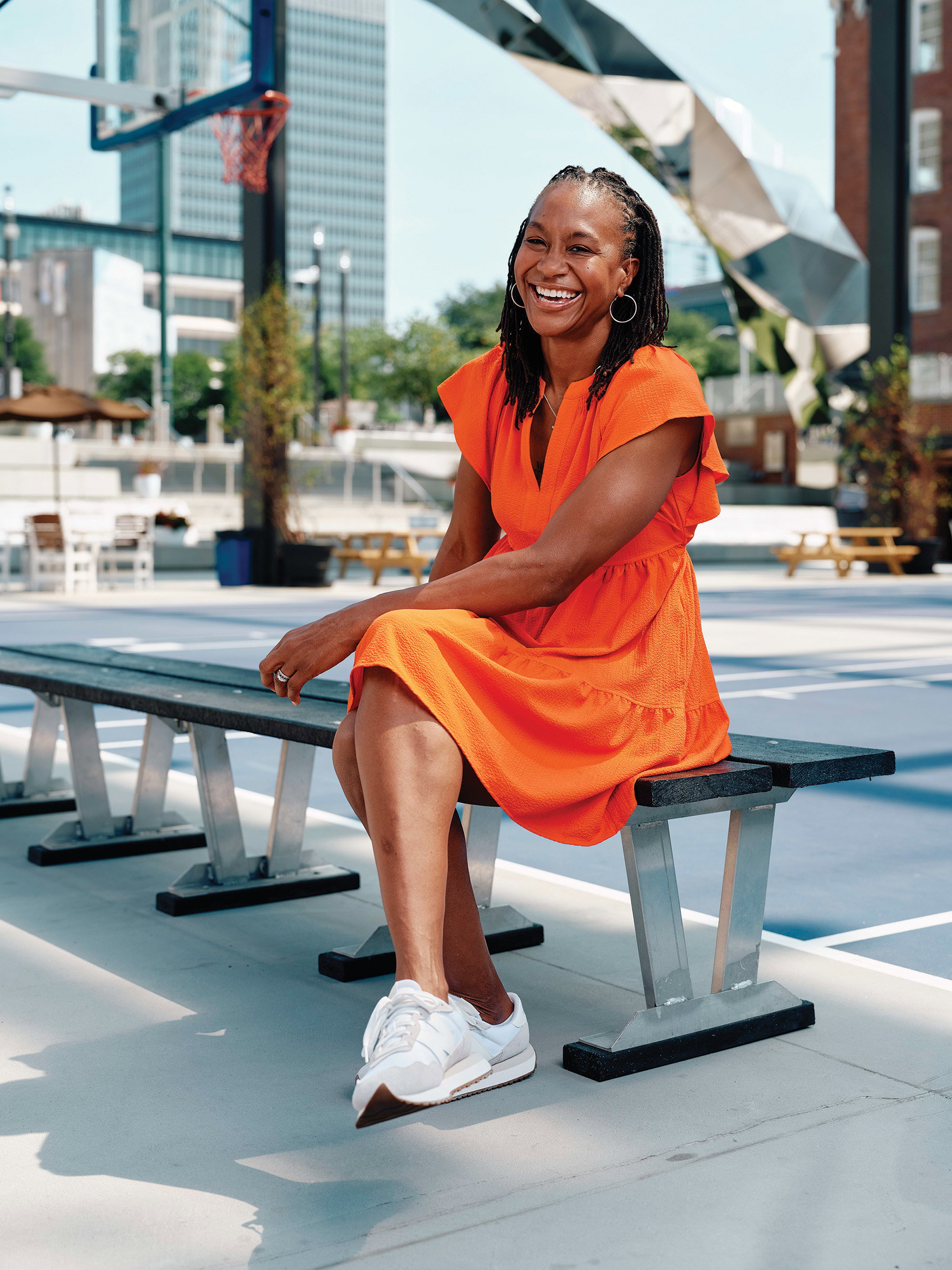
Can you share your feelings on becoming the Pacers Sports & Entertainment ambassador and being back in the limelight in an official capacity?
One of the blessings that I’ve had after retiring is I became the director of player programs and franchise development. I spent time with the Fever, the Pacers, and the Mad Ants and became full-time underneath the Fever from 2019 to 2022. I was able to work with all our entities, represent each brand, be a part of the business partnership. … I’m fortunate to be a part of this community. That’s what my life has been about, and I wanted to continue focusing on that and continuing to show how basketball unites people.
You were born in New Jersey and moved around a lot as a kid, but since you retired from pro basketball, you’ve called Indiana home. What made you stay?
It’s always been the people. I was hurt my rookie year, so I got involved in the community. They’ve always welcomed and supported me here. My family is here; the organization is here; Catch the Stars Foundation and Tea’s Me [which recently shifted focus to amplifying its university model and bottled tea line] are here. I love what we’ve built.
Last season, the Fever and the Pacers both came a game short of making history. As someone who made it to the finals three times in your career and brought a title to Indy, describe how hard it is to make deep runs like that.
They’re all unique in so many ways. For us, we got to the WNBA Finals in 2009, and our nemesis was the Detroit Shock. We lost to them three years straight, and we knew if we could beat them, anything could happen. After that, it took us three years until we were able to win a championship. It’s hard to get there, but when you do, it’s about every moment that goes into it. In 2012, we had the opportunity to come back before our finals game against Minnesota or travel immediately there. We went straight there, and in that four-day layover, that team bonding and talking about what it takes to win were crucial. Nobody expected us to get there, and that’s the beauty of the Pacers’ and Fever’s recent runs. No one expected them to get that far.
You’ve won a championship. You’re an Olympic gold medalist. You’re a Women’s Basketball Hall of Famer. When you’re formally introduced, which do you like mentioned?
The thing that I’m most proud of is our foundation, being able to impact as many youths as we have. We serve over 1,500 kids a year. We’ve given out over $1 million in scholarships since 2001. … So when someone introduces me, I would like it to be about that. Many of those kids we serve don’t even know I played basketball. But if I had to look at winning and accolades, they’re all amazing. With the Olympics, you’ve got the best in the world on one team; you’re expected to win. So I would go with our 2012 championship, because no one expected us to win. We had injuries impact our best shooters, and so then it was next man up. We showed the true characteristics of team basketball.
Your coaches had a lot of influence on you, especially University of Tennessee Lady Volunteers coach Pat Summitt.
When I think of Pat and her influence on my life, it’s about living every moment and going 100 percent. Those who know me know the way I played is the way I do business. It’s the person I am. Every single situation, I’ll be 100 percent there.
What’s the most important lesson you’ve learned since you retired?
The value of community and showing up. In this world, we’ve become so money-driven that it feels like we’ve lost touch with the things that matter. With basketball, I basically got paid to go to gym class every single day. Now on this side of the game, I’ve learned how much work goes into all of this. As a player, you don’t think about all the things that go into the business side. For example, the first time I did an expense sheet was interesting, but it’s cool to look back on the last 10 years and see how much I’ve grown.
Being a television announcer and general manager and vice president of basketball operations for the Fever, you learn so much. One role that served me, but that I was hesitant to accept, was as a part of the committee that picked the USA Basketball U16 Team. That taught me how to put together a draft board, evaluate talent, and create a team.
Has commentating and working with Team USA and the Fever given you any new perspectives?
It’s a running joke! I say if I watched as much film then as I do now, who knows how good I could have been?
What stands out to you in terms of how the game is played differently now?
It’s the talent and the opportunities. The WNBA is going into its 30th year. The young players now watch the game, meet the pro players, dream about it. They’re starting younger in every facet. You have an opportunity to show them that the only difference with the WNBA is the gender. There are so many opportunities available now when you look at girls’ sports, and the growth has been exciting to watch.
What do you think you and others have passed down to the league today?
Every player wouldn’t have had the opportunity without Title IX. And each brought something unique. I was watching comparisons of Caitlin Clark’s game to Diana Taurasi’s knowing that Maya Moore is Caitlin’s favorite player. You see moves and traits. Aliyah Boston had A’ja Wilson to practice against in college and now faces her in the league. It’s cool to see the WNBA and NBA come together in the fabric of the game.
You and others laid the foundation for the collective bargaining agreement (CBA) the WNBA signed this past offseason. How do you feel about being a part of something so monumental?
This is going to go in the history books. When you see comparisons of the CBA from then until now, it’s night and day. Before, it was comparing what the NBA had and what the WNBA needed. Now, in the last two CBAs, it’s transitioned into what do we need as women? Family planning, having an extra room for nannies during road trips … there’s so much more involvement around families and our sport.


