



Luzemberg Santana
At the age of 10, Brazilian native Luzemberg Santana won what amounts to a professional dancer’s version of the lottery. The odds against him were certainly as long as those against the average Powerball player. He was one of 62,000 children who auditioned for a scholarship to the ultra-prestigious Bolshoi Theatre School in Brazil. And he became one of only eight of those applicants to receive a scholarship.
“I had to live far away from my family for eight years until I graduated,” Santana says.
Hundreds of miles away from his home in northeast Brazil, he painstakingly honed his skill in a demanding discipline, changing the trajectory of his life and earning a ticket to a career performing around the world.
Indianapolis audiences know him as one of Indianapolis Ballet’s newest principal dancers. But his journey here included professional contracts in multiple countries, years of elite training, and an unwavering commitment to improvement—because while ballet may look effortless to an audience, Santana knows better. And he has the aches and pains to prove it.
Delivering a great performance, he says, requires not just technical precision but also emotional control, constant communication with fellow dancers, and, of course, pure physical endurance and prowess. A principal dancer must be an athlete, actor, and artist all at once.
“Once you figure out your identity on stage, I think you’ve found the way to make yourself and the audience happy,” he says.
When the Indianapolis Ballet season concludes, Santana decamps to Brazil, where he works on community projects and manages his own clothing company, 5ive4orty, which creates streetwear for the ballet community. He also works on growing his social media presence, offering training tips and slice-of-life vignettes to his more than 15,000 Instagram followers, and mentors younger performers trying to build their own careers.
Santana sees enormous potential in the Indianapolis art scene. He believes the city can become an even more prominent destination for classical ballet and hopes to contribute to that growth.
“I believe in Indianapolis,” he says. “I think it’s a place where ballet can grow and be recognized.”

Kyng Rhodes
When painter and muralist Kyng Rhodes was 3 years old, he used some of his mother’s makeup to draw his first mural—on the walls of his house. Most parents would have seen red, but his mother examined his work and saw potential.
“She looked at the drawings and thought it was better than what’s to be expected of a 3-year-old,” Rhodes recalls.
The incident launched him on a lifelong artistic journey. During his youth in Indianapolis, Rhodes gravitated toward every art program he could find, eventually earning a degree in graphic design. Yet even as he built a career in the corporate world, his true passion remained painting. The pivotal moment came in 2020, when he helped create the Black Lives Matter mural on Indiana Avenue. The project generated enormous attention.
It also cost him his graphic design job. But it was hardly a disaster. Deprived of his corporate gig, he decided to go all-in on painting.
“I put all my effort into what I had already been doing at home, which was my paintings, and I went for it,” he says.
Indianapolis is richer for his choice. Rhodes has emerged as one of the city’s most visible and thought-provoking artists. His paintings blend spirituality, social commentary, and symbolism with vivid color. A recurring element in his works is what he calls a “divine light” that draws viewers toward a deeper understanding of the subjects he portrays.
Though he often addresses serious topics such as race, faith, and environmental stewardship, Rhodes refuses to dwell in darkness. Flowers, bright colors, and glowing figures populate his canvases.
In an era when outrage often dominates public conversation, he remains committed to finding the beauty and the light in even the gloomiest corners. He’s also a supporter of his fellow artists, using exhibitions and collaborations to elevate their creative voices.
“I want people to smile, and I want to make them happy,” he says.
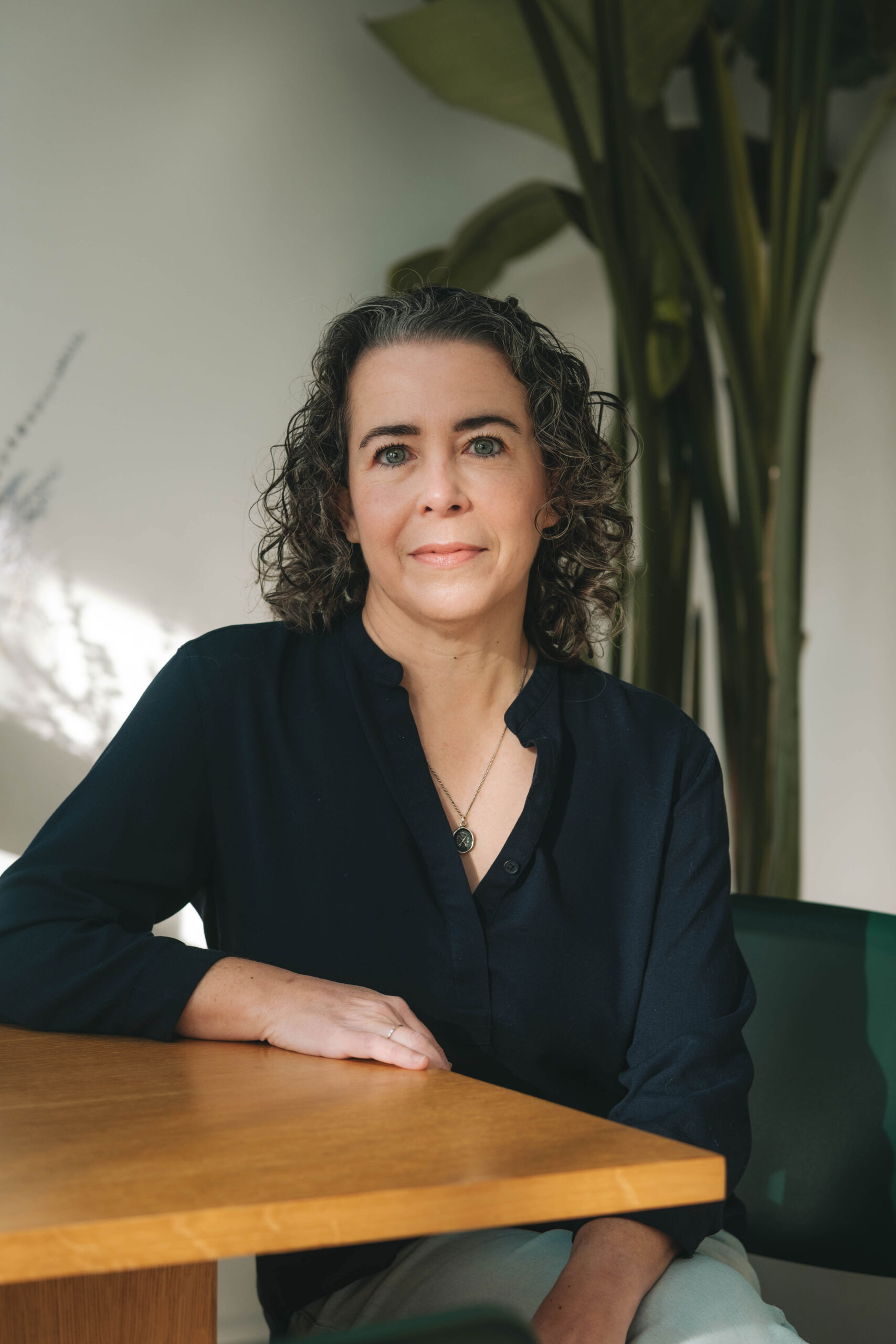
Shasta Grant
Writer Shasta Grant, author of the recently released novel When We Were Feral, about a group of girls growing up in a small New England town, is finally ready to start calling herself a Hoosier.
She grew up in the small town of Newport, New Hampshire, earned an MFA from Sarah Lawrence College, lived in China and Singapore for several years, and moved to Indianapolis in 1999. Though most of her short stories, including flash fiction, and longer works are set in New England, she’s toying with the idea of writing an Indiana story.
“I think this is really home now,” she says.
Grant didn’t take the shortest, most efficient route to Indy, and her path to authorship was just as meandering. She worked as a paralegal before enrolling in a community workshop at Butler University. That class changed everything. Encouraged by English professor and author Dan Barden, she pursued graduate school and eventually built a career as an author, editor, teacher, and writing coach. In addition to publishing acclaimed short stories, she also serves as coordinating editor of the flash fiction journal SmokeLong Quarterly and is the cofounder of Brown Bag Lit, an online literary community offering lunchtime classes, writing groups, and accountability sessions for people who can’t or won’t do “in-person” workshops.
One of Brown Bag Lit’s most successful programs, Lunch Break Writers, brings its far-flung student body together for virtual group writing sessions.
“The feedback that we get is really that it’s very powerful, that they wouldn’t be writing if they didn’t sit down and do it together,” Grant says.
Community has always mattered a great deal to her. While attending Sarah Lawrence, she led writing workshops in a women’s correctional facility, inspired in part by the fact that her own mother died in prison. She later continued similar work with women in other transitional programs.
As a novelist, Grant tells stories. As an editor and mentor, she’s helping others tell theirs.

Jessica Huang
Most playwrights spend their days exploring imaginary realities. Jessica Huang is currently exploring several.
On any given day, the James Still Playwright-in-Residence at the Indiana Repertory Theatre might be developing a new musical, revising a script, or working on an ambitious adaptation of H.G. Wells’ science-fiction classic The War of the Worlds.
“It’s fun,” she says. “You get to live in different worlds.”
For Huang, storytelling has always been tied to family and community. While growing up in Minnesota, she was involved in a community theater where everyone in her family pitched in. Her brother performed. Her father worked backstage. Her mother was a stage manager. The experience taught her that theater isn’t simply about individual creativity. It’s about people building something together.
That lesson guides her work today.
A former journalism student, Huang discovered that dialogue and storytelling excited her more than any other form of writing. She eventually built a nationally recognized career as a playwright whose work frequently explores questions of identity, belonging, and what it means to be American.
“I’m the descendant of immigrants,” she says. “I’m a product of immigrants from very different parts of the world coming together.”
Those themes continually surface in her work, even when she’s writing about Martian invasions and global catastrophe.
In Indianapolis, Huang’s role extends beyond writing. She participates in artistic planning at IRT and works closely with young playwrights through the theater’s educational programs. Those interactions, she says, reconnect her with the joy that first drew her to theater.
“I love being able to share what I know,” she says.
Although her permanent home is in New York City and she travels frequently, Huang holds Indianapolis dear. During her residency, she has become an enthusiastic advocate for the city’s arts community, praising both its creativity and its willingness to embrace new ideas.
“I really just treasure having a home in Indianapolis during this three-year residency,” she says.
For a playwright whose job is imagining new worlds, that’s perhaps the highest compliment she can offer.

D’yshe Mansfield
When D’yshe Mansfield was 9 years old, she was riding around in the car with her mother, enthusiastically singing along with a song on the radio. Or rather, absolutely owning a song on the radio.
“That’s how you can sing?” her mother asked, shocked.
Not long afterward, Mansfield was singing in church every Sunday. Then came performing arts programs in middle and high school, theater productions, music studies in New York City, and a growing reputation as one of Indy’s most versatile performers. Today, her resume includes singer, songwriter, actor, and photographer. But she doesn’t hesitate when asked which comes first.
“Singing is the one thing where I feel most free,” she shares.
After training in New York City, Mansfield returned to Indianapolis and her family. During the personal and societal upheaval of Covid, she craved both tighter familial bonds and a chance to rest and regroup creatively. Since then, she’s immersed herself in both performance and community work.
Her music emphasizes emotional honesty and human connections. The phrase she returns to repeatedly is, “You can’t hear what you can’t feel.”
Whether writing original songs or performing with her band, Mansfield hopes audiences see pieces of themselves in the stories she tells. Her recent single “Drive” explores themes of mental health and finding a safe place amid life’s challenges. But some of her most meaningful work happens offstage.
Mansfield recently completed a second degree in applied theater, television, and film and began working with React Theater, a local organization that helps young people develop and perform stories based on their experiences. Through workshops and theater projects, students learn that their voices matter.
“I think the work that I’m doing with React Theater is probably the most impactful right now,” she says.
That commitment to helping others forms the spiritual through line of Mansfield’s diverse body of work. She hopes to be remembered, she says, as someone who “always wanted to make everybody feel like somebody.”

Hannah Schendel
Even when Indianapolis Symphony Orchestra assistant conductor Hannah Schendel isn’t conducting an ISO performance, chances are she knows every note being played. Because one of her less-visible responsibilities is serving as the orchestra’s emergency backup conductor. That means learning major works throughout the season and being prepared to step up to the podium at a moment’s notice if circumstances require it.
Which, so far, they haven’t.
“I have not had to do it this year yet, knock on wood,” she says.
Not that there aren’t plenty of other tasks to occupy her time. Much of her work involves educational and outreach programs that introduce young people to classical music, including student concerts, school performances, and opportunities for amateur musicians to perform alongside professionals. She believes music education offers benefits that extend well beyond the concert hall.
“I think it teaches so many valuable life skills,” she says.
Originally from Minnesota, Schendel’s path to the podium was far from straightforward. She studied violin and piano and pursued a biology degree in college, with notions of going to medical school. But music kept calling to her.
“I loved playing with an orchestra,” she recalls. “I switched over to conducting because I enjoyed both the analytical approach to the music and the collegial nature of the work.”
The role demands far more than musical knowledge. Conducting is surprisingly physical, and Schendel mentions that many conductors battle shoulder injuries during their careers.
“I have to work out, especially my upper body,” she says.
Schendel came to Indianapolis because she was impressed by both the caliber of the orchestra and its commitment to community engagement. Working with kids and amateur musicians is important to her, as is supporting living and underrepresented contemporary composers. Whenever possible, she seeks opportunities to bring their works into the ISO’s repertoire, believing those emerging voices will shape the future of orchestral music.


