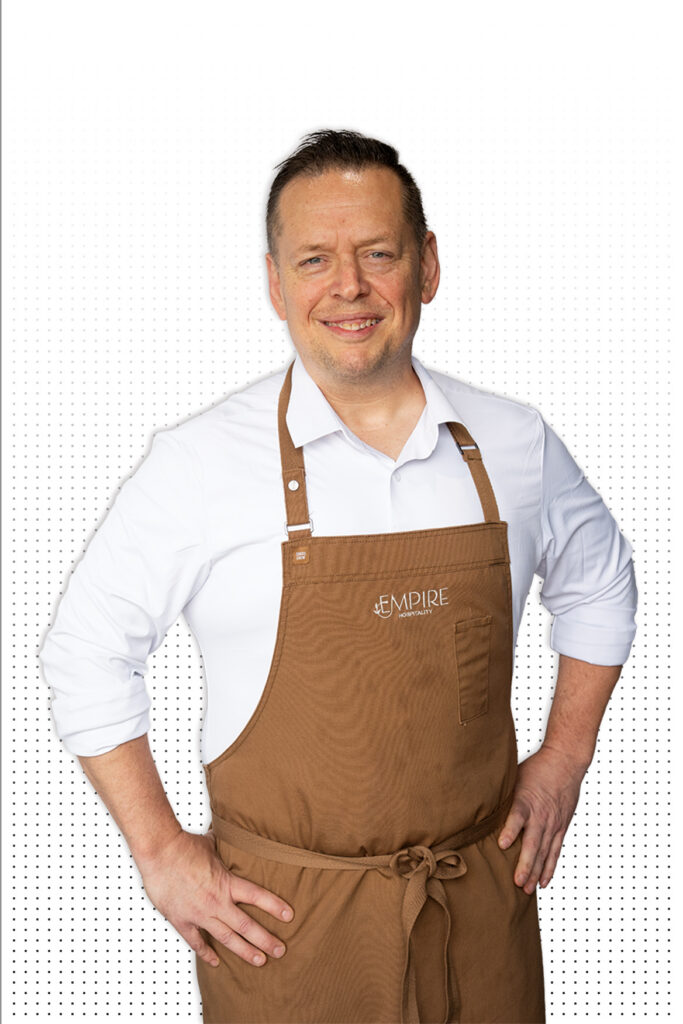
Cholita Modern Cantina, the always-busy Broad Ripple spot that has been serving sit-down tacos and margarita brunches for eight years as Cholita Taqueria has undergone a rebranding. Co-owner and executive chef Greg Howe is reimagining the location as a more serious chef-driven and ingredient-focused kitchen where diners can expect gourmet masa creations as well as collaborative one-off dinners like this summer’s Indiana Sweet Corn + Champagne Dinner featuring My Dad’s Sweet Corn and Moët Hennessy. Howe, a career chef and consultant who hails from Martinsville but whose work has taken him to places like New York, Los Angeles, and Dubai, has recently been focused on the restaurant he helped open in 2018, but intended to keep at arm’s length.
Why did you decide to roll out a new concept and menu at Cholita?
When we first opened the restaurant—that will have been eight years ago in November—I had a good job with a company called Richard Sandoval Restaurants, and I was traveling internationally and doing a lot of things. I met my partners here. They said they wanted to do a restaurant. My background is in Latin cuisine, specifically Mexico. I told them I would do this restaurant and give them a great menu. But I couldn’t be the chef. I couldn’t be there, and I didn’t want to do full-on dining. The focus was on cocktails—a bar with great food. So for seven years we swung a lot of tacos—especially during 2021. But drinking habits among younger people have changed, and the Broad Ripple demographic has ebbed and flowed. And so last year, I am sitting here looking at this restaurant that’s been in my life for seven years, and I just decided—you know what, I’m going to do more with it. Collectively as a group, we decided that we were going to make it beyond just tacos, cocktails, beer, and margaritas, and do some more extensive foods. We’re doing ceviches and crudos, market-driven dishes with lots of local ingredients—but still Mexican at its core, with tacos on the menu, because that’s my background.
How would you describe this updated version of Cholita?
We started calling it a “modern cantina.” It’s a play on the traditional cantina—the bars of Latin America—but updated, similar to how gastropubs evolved 15 years ago. Relaxed vibe, but high-end, crafted food instead of basic bar food. We’re in the early stages of the concept; the menu and the crowd are still evolving, but the response has been fantastic. I moved here from California and love what I call second- and third-generation California Mexican cooking—children of immigrants taking Mexican food and making it cool. So our original branding with Cholita was very ’90s LA—lots of tattoos and all that. When we started to get more serious about the food—I would say, “Listen, I’m going out and sourcing Hawaiian opah and snapper and bigeye tuna. I think we need to sort of work on our ambiance.” The softening of the design and the elements was necessary. We’re still tweaking logos, uniforms, and details. The menu itself is there and running, but the transition has been gentle. I can’t just pull nachos off the menu when I have people who’ve eaten here three times a week for years. We’ve slowly introduced new dishes, watched the crowd and ambiance evolve.
Do you find that your younger Broad Ripple diners have more mature expectations?
I have a consulting company out of Maryland. We’re doing hotel consulting all the time, and what we’re finding is that the younger generations—Gen Y and Gen Z—are still spending, but they spend differently. And food is the same thing. We’re seeing that they actually spend more for food. They are going after things that are buzzworthy, of course. And that will always be there because of social media. But they’re also looking at things that they see online and that they appreciate as being of quality. Butler students used to be a big part of Broad Ripple. That’s still there, but not like it was before, where it was just this party street. Past 9 o’clock on any given night, people are there for an experience and for dining instead of just drinking. Broad Ripple has some challenges because of the closures, and we are sort of rebuilding the strip. Getting more chef-driven concepts is definitely on the docket.
What menu items have you been most excited about?
Over the summer, we bought huitlacoche from Wisconsin and using it in an empanada that we demoed at Rev. We did an Indiana corn tostada that everybody was nuts for. We’ve had aguachile and a ceviche with Hawaiian snapper. We had a seasonal salad of peaches and a salted pickled cabbage that I do, with cilantro crispy rice, which made with sort of a Thai-type salad. Entree-wise, we had a very good cod that we rub in something called chintextle, which is an ancient paste. It’s kind of like a mole, but it has salted dried shrimp in it. It creates this umami flavor that is not unlike miso. So I call it a Mayan miso cod. We have an arroz con pollo, and then we do an espada, which is literally a sword of all local steaks, pork, and chicken. I buy a sausage from Old Major, an Argentine version, because it grills better. And we literally grill it on this sword and carve it over a skillet of melted queso fundido.
And you are continuing Cholita’s occasional “tacokase” service. Explain what that is.
It is essentially an omakase-style taco experience with seven or eight courses. Everything starts with masa—we use nixtamalized corn as the primary vehicle for everything. And, look, we use “taco” as a loose term, because I’ve done tetelas, I’ve done tostadas. I did a shrimp soup made with what’s called chochoyotes, which are little dumplings of nixtamalized corn dough. The meal progresses from light to heavier. I get asked all the time, if this is authentic. And I tell them this: Mexico is very complicated. It is much more complex than “traditional” Mexican food. It’s like American food. If you went to Texas and said, “Cook me traditional American food.” What would you get? It’s very regional. It’s very diverse. It’s very complex. And Mexicans cook geographically. They eat things that are available in their area. It’s a very European style of eating because of necessity. What I always tell people when they come in is that they have to trust me that what I’m serving is something that has roots in the great food of Mexico. In my opinion, the best food in the world.