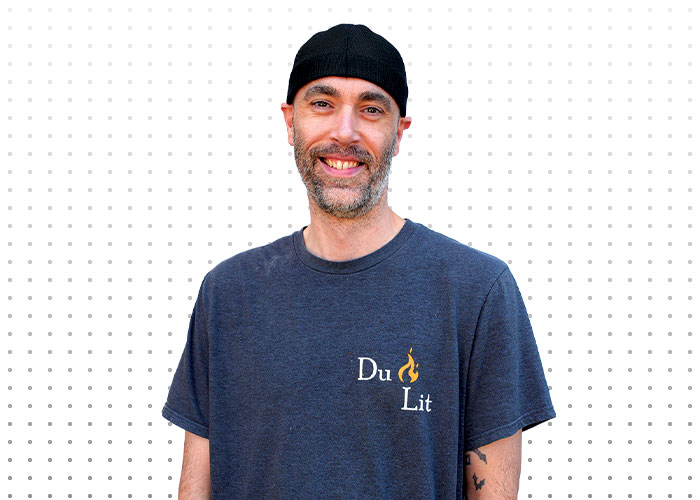
Preston Zwolle has spent much of his life in the restaurant industry, moving from managing a pizza shop at the age of 17 to overseeing multiple locations for Donatos and HotBox Pizza. After persistent stomach problems led him to give up gluten and dairy and lose 86 pounds, he found it increasingly difficult to order foods he could both tolerate and truly enjoy at a restaurant. That experience inspired him to open Du Lit, a dietary-inclusive casual restaurant in downtown Fortville with a menu built around the foods that he (and his appreciative customers) can eat.
What were the circumstances that prompted you to change the way you were eating?
I always had issues with my stomach, and I wasn’t sure what it was. First, I gave up fast food, and then I gave up soda, and then I still had issues where my stomach was either turning or just uncomfortable. One day I was looking at myself in the mirror—I was actually cutting my own hair—and I just didn’t like my reflection anymore, to be honest with you. So I decided to give up dairy and gluten and work out every day. I did that for almost nine months and lost around 86 pounds. I felt so much better, but it was a struggle to eat out at restaurants because so many things have flour in them, or breadcrumbs, or even a roux to make sauces thicker. I had to figure out how to cook all those meals with food I could eat.
In 2024, you opened your own restaurant with a menu that focuses on gluten- and lactose-free options. How was Du Lit received at first?
I have worked in restaurants for pretty much half my life, and I always wanted to open a restaurant of my own. I had names picked out and different concepts. The way my menu is set up might be confusing to people who don’t understand what lactose-free or gluten-free is, mainly because they don’t have those issues. For example, we don’t have sliced American cheese. We don’t have a freezer, microwave, or fryer. Some people don’t understand why they can’t get fries with their burger. But people who do have those issues come up and thank me on almost a daily basis. We try to be as healthy as we can but still feed everybody the food that we like.
Many restaurants these days will accommodate people with specific dietary needs, either by offering a handful of suitable dishes or by altering existing menu items. Why was it important for you to make your gluten-free and lactose-free menus the focus of Du Lit instead of a compromise?
It’s easier not to have to change something for a request. If people can eat my food and not even know that, for example, my spinach-and-artichoke dip is lactose-free, why do I need to tell them that? Why make a dish the traditional way and then have to change it? All of my desserts are gluten-free. I’ve had people literally tear up in my dining room because they are eating gluten-free items for dessert. The other reason is space. I have very small refrigerators, and I barely have the space to do what I’m doing, let alone make all these alternate items.
Has this process forced you to become a more creative chef?
Yes, very much so. For example, I had this product sent to me with the wrong sticker on it. It was supposed to be corn. It was sun-dried tomatoes, and they’re vacuum packed. They sat on my shelf for two weeks, waiting for the truck driver to come pick them up to give me credit. Finally, I was told they’re not picking up the product and I could either throw the tomatoes away or use them. So, I opened this package of tomatoes and decided to make a pasta with garlic and thyme seasoning, sun-dried tomatoes, mushrooms, onions, and shaved steak. It became a steak version of Alfredo, and it was so good that I did a little happy dance. We offered is as a special. Everyone loved it, and now it’s on the menu. I came up with a lactose-free queso that is somewhat neutral so that I can use it as a base for all of my lactose-free sauces. You can dip your chips in this queso, but if I add different seasonings and ingredients to it, it becomes my stroganoff sauce or I can turn it into my Alfredo sauce, which is my best seller. I’m really proud of it. I’m still teaching myself. I’m still learning about different ingredients. But I won’t put something in front of my customers if I’m not 100 percent on it.